Spray Foam Insulation in Wilmington, NC
Residential & Commercial Spray Foam Solutions for Wilmington Properties
Wilmington Spray Foam Installation helps homeowners, builders, commercial property owners, and structure owners plan and install spray foam insulation across Wilmington and surrounding southeastern North Carolina communities. We specify and apply both open-cell and closed-cell spray foam for attics, crawl spaces, walls, roof decks, metal buildings, pole barns, garages, and new construction. Whether your project is a single-family home, a commercial structure, or an agricultural building, request a free estimate and let us review the right approach for your assembly. Call (910) 909-4411 to discuss your insulation project.
Residential Spray Foam Insulation for Wilmington, NC Homes
Residential spray foam insulation is the application of spray-applied polyurethane foam to the assemblies that make up a home’s thermal envelope—attics, rooflines, crawl spaces, exterior wall cavities, rim areas, and garages. Unlike traditional loose or batt insulation, which is placed into cavities and can leave gaps around framing, wiring, and penetrations, spray foam expands on application to help seal the surfaces it covers. That air-sealing characteristic is what draws many Wilmington homeowners to it.
Air sealing matters because uncontrolled air leakage is one of the largest contributors to comfort problems and energy waste in residential buildings. When warm, humid coastal air moves freely through attics, crawl spaces, and wall assemblies, heating and cooling equipment work harder to keep up. Spray foam can help reduce that uncontrolled air movement when properly specified and installed, supporting a tighter, more continuous building envelope.
Wilmington’s warm, humid summers make the building envelope especially relevant. High attic temperatures, humid crawl spaces, and moisture-laden air can all affect how a home feels and performs. Spray foam does not solve every moisture problem, and product choice plus assembly design matter—open-cell and closed-cell foam behave differently and are appropriate for different parts of a home. That is why each residential project starts with a review of how the home is built and what the insulation goals are.
Where Residential Spray Foam Can Be Installed
- Attics and roof decks
- Rooflines and unvented attics
- Crawl spaces and rim areas
- Exterior wall cavities
- Garages and bonus rooms
- Home additions
- New construction framing
- Existing-home retrofits
Why Wilmington Property Owners Consider Spray Foam
Wilmington sits in a coastal climate where hot, humid summers and mild winters keep heating and cooling systems running much of the year. Property owners often consider spray foam to address attic heat, crawl-space humidity, drafty rooms, and the discomfort that comes from an underperforming thermal envelope. When the envelope is tighter and better insulated, indoor temperatures can stay more consistent and the load on HVAC equipment may be reduced. Results depend on the whole-building assembly, existing insulation, and how the foam is specified and installed—not on insulation alone.
Wilmington Spray Foam Installation serves property owners looking for professionally planned spray foam insulation solutions in Wilmington and surrounding communities. We focus on reviewing your building, understanding your goals, and recommending an approach that fits the assembly—rather than applying one product everywhere. Learn more on our About Us page.
Spray Foam Insulation Services in Wilmington, NC
From whole-home residential air sealing to commercial structures and agricultural buildings, these are the spray foam applications we plan and install across Wilmington and southeastern North Carolina. Each service is matched to the building assembly and your project goals.
Residential Spray Foam Insulation Wilmington, NC
Whole-home air sealing and insulation for Wilmington properties, covering attics, rooflines, crawl spaces, walls, and garages. Residential spray foam is planned around how your home is built and how you use it, helping reduce uncontrolled air leakage and support more consistent comfort across the living space.
Explore residential spray foam insulationCommercial Spray Foam Insulation Wilmington, NC
Thermal envelope and air barrier solutions for Wilmington commercial properties, including retail, warehouse, and mixed-use structures. Spray foam can help manage air leakage and support building-envelope performance across larger assemblies when properly specified for the building type.
Commercial spray foam insulation in WilmingtonAttic Spray Foam Insulation Wilmington, NC
Applying foam to the underside of the roof deck can bring the attic into the conditioned envelope, which may help reduce attic heat buildup common in coastal North Carolina summers. Attic spray foam is one of the most requested residential applications for supporting even indoor temperatures.
Attic spray foam insulationCrawl Space Spray Foam Insulation Wilmington, NC
Foundation wall and rim area insulation for conditioned or encapsulated crawl spaces. Closed-cell foam is often selected here for its lower vapor permeance relative to open-cell products, as part of a correctly planned moisture and air management assembly beneath the home.
Crawl space spray foam insulationOpen-Cell Spray Foam Insulation Wilmington, NC
A lower-density foam that expands to fill cavities and is commonly used for interior air sealing in attics and wall assemblies. Open-cell spray foam can also help dampen sound between rooms and is often a cost-conscious choice for whole-home interior applications where appropriate.
Open-cell spray foam insulationClosed-Cell Spray Foam Insulation Wilmington, NC
A denser, more rigid foam with lower vapor permeance relative to open-cell products. Closed-cell spray foam is frequently selected for metal buildings, pole barns, crawl spaces, and commercial or agricultural assemblies where added rigidity and moisture resistance may be beneficial.
Closed-cell spray foam insulationPole Barn Spray Foam Insulation Wilmington, NC
Post-frame building insulation that helps reduce seasonal temperature swings and roof condensation. Spray foam applied to pole barn walls and roofs can support a more workable interior environment for storage, workshops, and livestock or equipment structures.
Pole barn spray foam insulationMetal Building Spray Foam Insulation Wilmington, NC
Direct-to-metal application that helps address condensation, thermal bridging, and interior temperature control on steel structures. Closed-cell foam is commonly used on metal roofing and walls to support building-envelope performance in coastal North Carolina climates.
Metal building spray foam insulationGarage Spray Foam Insulation Wilmington, NC
Thermal control for attached, detached, and workshop garages to help maintain more workable temperatures year-round. Insulating garage walls and ceilings can also reduce heat transfer between the garage and adjacent living space in attached-home layouts.
Garage spray foam insulationNew Construction Spray Foam Insulation Wilmington, NC
Insulation planned and installed during the build, while framing, cavities, and roof decks are fully accessible. Designing the thermal envelope and air barrier early lets spray foam be integrated into the overall assembly for new homes and commercial builds in Wilmington.
New construction spray foam insulationExisting Home & Retrofit Spray Foam Insulation Wilmington, NC
Insulation upgrades for older Wilmington homes, targeting attics, crawl spaces, and accessible wall and rim areas. A retrofit evaluation reviews existing materials, building access, and assembly design to determine whether open-cell, closed-cell, or another approach fits the project.
Existing home & retrofit spray foam insulationRoof Deck & Roofline Spray Foam Insulation Wilmington, NC
Unvented attic conversions that bring ductwork and the attic into the conditioned building envelope. Applying foam to the roof deck and roofline can help reduce attic heat gain and support more efficient heating and cooling when the assembly is correctly designed.
Roof deck & roofline spray foam insulationAgricultural & Farm Building Spray Foam Insulation Wilmington, NC
Climate regulation support for equipment barns, storage structures, and rural buildings across southeastern North Carolina. Spray foam can help manage interior temperature and condensation in agricultural buildings where durable, low-maintenance insulation is useful.
Agricultural & farm building spray foam insulationAverage Cost & Pricing for Spray Foam Insulation in Wilmington, NC
Spray foam insulation cost in Wilmington, NC varies according to the individual project rather than one universal price. Pricing may be affected by total square footage being insulated, the actual sprayable surface area, open-cell versus closed-cell spray foam, required foam thickness, and whether the application is an attic, crawl space, wall, roof deck, or building envelope. New construction versus retrofit work, residential versus commercial scale, accessibility, ceiling or roof height, crawl-space clearance, and existing insulation can also influence cost. Where applicable, insulation removal, surface preparation, masking and overspray protection, the number of penetrations and irregular framing areas, substrate condition, metal versus wood framing, moisture conditions, ventilation considerations, mechanical systems in the work area, and overall project complexity may affect the final scope. In southeastern North Carolina, coastal humidity, crawl-space moisture conditions, attic heat, and metal-building condensation concerns can all shape what a given project requires.
Pricing shown below represents general planning ranges for spray foam insulation projects in the Wilmington area. These figures are not fixed prices, advertised quotes or Wilmington-specific historical averages. Actual pricing requires evaluation of the property, sprayable surface area, foam type, required thickness, accessibility, existing insulation, substrate conditions and overall project scope.
| Service | Materials, Labor & Major Cost Factors | Typical Wilmington-Area Planning Range |
|---|---|---|
| Residential Spray Foam Insulation | Areas being insulated, total sprayable square footage, foam type, foam thickness, attic/walls/crawl space or roof deck, existing insulation, access, surface preparation, and new construction versus retrofit. | $2,000–$20,000+ Smaller targeted residential applications may fall toward the lower portion of the range, while whole-home, multi-area or higher-thickness projects can cost substantially more. |
| Commercial Spray Foam Insulation | Building size, wall and roof coverage, ceiling height, open-cell versus closed-cell foam, thickness, lift or equipment access where applicable, new construction versus retrofit, surface preparation, and project staging. | $5,000–$75,000+ Small commercial applications can cost considerably less than large warehouses, retail buildings, industrial spaces or projects involving extensive wall and roof coverage. |
| Attic Spray Foam Insulation | Roof-deck square footage, open-cell versus closed-cell foam, foam thickness, roof pitch, attic height, accessibility, existing insulation, mechanical equipment, penetrations, and prep and masking. | $1,500–$12,000+ Smaller, accessible attic areas may fall near the lower portion of the range, while large or complex roof decks and higher material requirements can increase project cost. |
| Crawl Space Spray Foam Insulation | Crawl-space dimensions, wall or floor-system application, clearance, access, closed-cell foam requirements, existing insulation, surface conditions, rim joists, penetrations, and preparation work. | $1,200–$8,000+ Accessible crawl spaces requiring targeted insulation generally cost less than larger or difficult-access projects involving extensive preparation or additional areas. |
| Open-Cell Spray Foam Insulation | Square footage, thickness, application area, framing configuration, attic or wall access, masking, surface preparation, labor, and project size. | $1,500–$15,000+ Open-cell material is commonly evaluated according to sprayable area and required installed thickness. Open-cell foam is not appropriate for every application. |
| Closed-Cell Spray Foam Insulation | Sprayable square footage, foam thickness, required insulation level, wall/crawl-space/roof or metal-building application, surface preparation, access, framing, substrate, labor, and project scale. | $2,000–$25,000+ Closed-cell applications typically require different material quantities and installed thicknesses than open-cell projects, making accurate measurements especially important. |
| Pole Barn Spray Foam Insulation | Building dimensions, wall coverage, roof coverage, ceiling height, open-cell versus closed-cell foam, thickness, metal-panel condition, equipment access, doors and openings, and surface preparation. | $3,500–$20,000+ Roof-only or smaller pole-barn projects generally cost less than insulating extensive wall and roof surfaces with thicker closed-cell applications. Larger buildings can exceed the displayed planning range. |
| Metal Building Spray Foam Insulation | Building dimensions, wall and roof surface area, ceiling height, foam thickness, open-cell or closed-cell selection, metal substrate condition, surface preparation, access, doors and penetrations, and new construction versus retrofit. | $3,500–$45,000+ Small metal buildings can fall toward the lower end, while larger commercial-size structures and complete wall-and-roof applications can substantially exceed entry-level project costs. |
| Garage Spray Foam Insulation | Garage size, walls versus ceiling/roof deck, attached versus detached configuration, foam type, thickness, existing drywall or insulation, accessibility, doors, and surface preparation. | $1,500–$10,000+ Single-bay or partial-wall garage projects typically cost less than larger detached garages or full roof-deck and wall applications. |
| Workshop Spray Foam Insulation | Workshop dimensions, wall and roof coverage, building material, desired foam thickness, conditioned versus unconditioned use, ceiling height, equipment inside the building, access, and preparation. | $2,000–$15,000+ Smaller hobby workshops with partial coverage generally cost less than large conditioned workshops with full wall and roof insulation. |
| New Construction Spray Foam Insulation | Home or building size, exterior wall area, roof deck, framing configuration, foam type, thickness, number of stories, project sequencing, builder requirements, and total coverage area. | $5,000–$30,000+ Smaller single-area new-construction scopes cost less than whole-home or multi-assembly builds that combine walls, roof deck, and crawl space. |
| Existing Home & Retrofit Spray Foam Insulation | Existing insulation, accessibility, removal where needed, finished versus unfinished areas, attic or crawl-space configuration, foam type, surface preparation, protection of existing finishes, and total area. | $3,000–$25,000+ Targeted retrofit areas with good access generally cost less than whole-home upgrades involving removal, preparation, and multiple assemblies. |
| Roof Deck & Roofline Spray Foam Insulation | Roof-deck area, roof pitch, foam type, foam thickness, attic accessibility, rafters and penetrations, existing insulation, mechanical equipment, and prep and masking. | $1,500–$12,000+ Smaller accessible roof decks cost less than large or steep-pitch roofs requiring more material and preparation. |
Areas being insulated, total sprayable square footage, foam type, foam thickness, attic/walls/crawl space or roof deck, existing insulation, access, surface preparation, and new construction versus retrofit.
$2,000–$20,000+
Smaller targeted residential applications may fall toward the lower portion of the range, while whole-home, multi-area or higher-thickness projects can cost substantially more.
View residential spray foam insulation servicesBuilding size, wall and roof coverage, ceiling height, open-cell versus closed-cell foam, thickness, lift or equipment access where applicable, new construction versus retrofit, surface preparation, and project staging.
$5,000–$75,000+
Small commercial applications can cost considerably less than large warehouses, retail buildings, industrial spaces or projects involving extensive wall and roof coverage.
Explore commercial spray foam insulationRoof-deck square footage, open-cell versus closed-cell foam, foam thickness, roof pitch, attic height, accessibility, existing insulation, mechanical equipment, penetrations, and prep and masking.
$1,500–$12,000+
Smaller, accessible attic areas may fall near the lower portion of the range, while large or complex roof decks and higher material requirements can increase project cost.
Explore attic spray foam insulationCrawl-space dimensions, wall or floor-system application, clearance, access, closed-cell foam requirements, existing insulation, surface conditions, rim joists, penetrations, and preparation work.
$1,200–$8,000+
Accessible crawl spaces requiring targeted insulation generally cost less than larger or difficult-access projects involving extensive preparation or additional areas.
Learn about crawl space spray foam insulationSquare footage, thickness, application area, framing configuration, attic or wall access, masking, surface preparation, labor, and project size.
$1,500–$15,000+
Open-cell material is commonly evaluated according to sprayable area and required installed thickness. Open-cell foam is not appropriate for every application.
View open-cell spray foam insulationSprayable square footage, foam thickness, required insulation level, wall/crawl-space/roof or metal-building application, surface preparation, access, framing, substrate, labor, and project scale.
$2,000–$25,000+
Closed-cell applications typically require different material quantities and installed thicknesses than open-cell projects, making accurate measurements especially important.
View closed-cell spray foam insulationBuilding dimensions, wall coverage, roof coverage, ceiling height, open-cell versus closed-cell foam, thickness, metal-panel condition, equipment access, doors and openings, and surface preparation.
$3,500–$20,000+
Roof-only or smaller pole-barn projects generally cost less than insulating extensive wall and roof surfaces with thicker closed-cell applications. Larger buildings can exceed the displayed planning range.
Explore pole barn spray foam insulationBuilding dimensions, wall and roof surface area, ceiling height, foam thickness, open-cell or closed-cell selection, metal substrate condition, surface preparation, access, doors and penetrations, and new construction versus retrofit.
$3,500–$45,000+
Small metal buildings can fall toward the lower end, while larger commercial-size structures and complete wall-and-roof applications can substantially exceed entry-level project costs.
Learn about metal building spray foam insulationGarage size, walls versus ceiling/roof deck, attached versus detached configuration, foam type, thickness, existing drywall or insulation, accessibility, doors, and surface preparation.
$1,500–$10,000+
Single-bay or partial-wall garage projects typically cost less than larger detached garages or full roof-deck and wall applications.
View garage spray foam insulationWorkshop dimensions, wall and roof coverage, building material, desired foam thickness, conditioned versus unconditioned use, ceiling height, equipment inside the building, access, and preparation.
$2,000–$15,000+
Smaller hobby workshops with partial coverage generally cost less than large conditioned workshops with full wall and roof insulation.
View workshop spray foam insulationHome or building size, exterior wall area, roof deck, framing configuration, foam type, thickness, number of stories, project sequencing, builder requirements, and total coverage area.
$5,000–$30,000+
Smaller single-area new-construction scopes cost less than whole-home or multi-assembly builds that combine walls, roof deck, and crawl space.
View new construction spray foam insulationExisting insulation, accessibility, removal where needed, finished versus unfinished areas, attic or crawl-space configuration, foam type, surface preparation, protection of existing finishes, and total area.
$3,000–$25,000+
Targeted retrofit areas with good access generally cost less than whole-home upgrades involving removal, preparation, and multiple assemblies.
View existing home retrofit spray foam insulationRoof-deck area, roof pitch, foam type, foam thickness, attic accessibility, rafters and penetrations, existing insulation, mechanical equipment, and prep and masking.
$1,500–$12,000+
Smaller accessible roof decks cost less than large or steep-pitch roofs requiring more material and preparation.
View roof deck spray foam insulationWhat Affects Spray Foam Insulation Cost in Wilmington?
Spray foam pricing in the Wilmington area is primarily influenced by the sprayable square footage, the foam type selected, and the installed thickness required to meet your insulation goals. The location of the installation matters as well — an attic roof deck, a crawl space, exterior walls, or a metal-building roof each carry different access and preparation requirements.
Accessibility, existing insulation, and surface preparation can change scope considerably, as can the difference between new construction and retrofit work. Building height, roof and framing complexity, residential versus commercial scale, and equipment access all play a role in how much material and labor a project requires.
In coastal North Carolina, conditions such as crawl-space moisture, attic heat, and metal-building condensation concerns can add preparation steps that influence cost. Because material quantity and labor requirements scale with the actual sprayable surface — not floor square footage alone — two similarly sized buildings can have meaningfully different project pricing.
A note on board feet: Spray foam may also be discussed in terms of board feet. One board foot represents one square foot of material installed one inch thick. Actual project pricing cannot be determined from floor square footage alone because the amount of material required changes according to surface area, foam thickness, foam type, framing geometry, and application location. A project-specific evaluation is the most reliable way to estimate cost.
These figures are preliminary planning ranges rather than advertised fixed prices for Wilmington-area spray foam insulation projects. Final pricing may be higher or lower depending on measurements, sprayable surface area, foam type, installed thickness, access, existing insulation, preparation requirements, substrate conditions and requested project scope. An on-site or project-specific evaluation is required for accurate pricing.
Request an Accurate Spray Foam Insulation Estimate in Wilmington, NC
A more accurate estimate is possible when you share details such as your property address, type of property, the area being insulated, approximate dimensions, and whether the project involves an attic, crawl space, walls, roof deck, garage, workshop, pole barn, or metal building. Let us know if it is new construction or existing construction, your open-cell or closed-cell preference if known, existing insulation, accessibility concerns, and photos of the project area when available. You do not need to already know which foam type you need.
Open-Cell vs. Closed-Cell Spray Foam in Wilmington
Neither open-cell nor closed-cell spray foam is universally “best.” The right choice depends on the building assembly, the area being insulated, your project objectives, and conditions specific to the property. Open-cell and closed-cell foam have different densities, expansion characteristics, and vapor behaviors, so selection should be based on where and how the foam will be used rather than on a single product being applied everywhere.
Open-Cell Spray Foam
Open-cell spray foam is a lower-density material that expands significantly on application, filling cavities and helping seal gaps in a single pass. Its softer, sponge-like structure is what gives it the “open-cell” name.
- Lower-density, expanding foam for interior air sealing
- Commonly used in attics and wall cavities where appropriate
- Can help dampen sound between interior rooms
- Often a cost-conscious choice for whole-home interior applications
Closed-Cell Spray Foam
Closed-cell spray foam is denser and more rigid, with lower vapor permeance relative to open-cell products. Its tighter cell structure makes it suitable for assemblies where moisture resistance and added rigidity are useful.
- Higher-density, rigid composition with greater structural contribution
- Lower vapor permeance relative to open-cell products
- Often selected for metal buildings and pole barns
- Used in crawl spaces and commercial or agricultural assemblies where suitable
Not Sure Which Spray Foam Fits Your Project?
Tell us about your building and goals, and we’ll review the right approach for your assembly.
Where Spray Foam Insulation Can Help Wilmington Properties
Spray foam is a versatile insulation and air-sealing material used across a wide range of building types in southeastern North Carolina. The applications below show where it is commonly specified, and the benefits describe what it may help support when properly designed and installed—without guaranteeing any single outcome for every building.
Air Sealing
Spray foam expands to fill gaps and cavities, which can help reduce uncontrolled air movement through the building envelope when properly installed.
Thermal-Envelope Continuity
Continuous coverage across framing and hard-to-reach areas may improve thermal-envelope performance compared with insulation that leaves gaps.
Condensation Considerations
When correctly designed, spray foam may play a role in condensation control for metal buildings, crawl spaces, and roof decks, depending on the assembly.
Comfort Support
Reducing air leakage and improving envelope continuity can support more consistent indoor comfort and may help heating and cooling equipment operate more efficiently.
The role spray foam plays depends on the building assembly. In an unvented attic it may help reduce heat gain; in a conditioned crawl space it may be part of a moisture and air management plan; on a metal building it may help address condensation. “Can help,” “may improve,” and “when properly specified and installed” are intentional—no insulation product is a universal solution, and results depend on how the whole assembly is designed.
Specialized Structures We’re Ready to Discuss
Beyond the core services above, spray foam is also useful for a range of specialized structures. If your project involves one of these, call to discuss the approach— dedicated pages for these applications are planned as the site expands.
What to Expect From a Spray Foam Insulation Project Near Wilmington
A clear, step-by-step process helps reduce uncertainty and keeps your project organized from first call to final review. Here is what to expect when you work with Wilmington Spray Foam Installation.
Project Discussion
We start by understanding your property type, insulation goals, and the areas of concern you want addressed.
Site Evaluation
We review the intended application areas and project conditions to understand how the building is assembled.
Spray Foam Recommendation
We determine whether open-cell, closed-cell, or another appropriate approach should be considered for your assembly.
Preparation
We prepare the work area and establish safe application conditions before any material is introduced.
Spray Foam Application
We apply material to the planned building surfaces and assemblies according to the agreed scope.
Final Review
We review the completed work and applicable project details so you understand what was done.
Safety & Re-Entry Guidance
Occupants may need to follow project-specific safety and re-entry guidance based on the product, the application, and contractor instructions. We do not publish arbitrary re-entry times, because the right guidance depends on the specific product and conditions. Any re-entry or ventilation instructions will be reviewed with you as part of your project.
Spray Foam Insulation Project Gallery in Wilmington, NC
The gallery below illustrates the types of residential, commercial, attic, crawl-space, open-cell, closed-cell, pole-barn, metal-building, workshop, garage, and new-construction spray foam projects Wilmington Spray Foam Installation is equipped to evaluate and complete throughout Wilmington and surrounding southeastern North Carolina communities. From attic spray foam insulation near Wilmington to crawl space and metal-building spray foam insulation in the area, these representative examples show common building assemblies and the conditions property owners may encounter.
Gallery images are representative service examples intended to illustrate common residential, commercial, attic, crawl-space, metal-building, and specialty spray foam insulation projects. Actual project appearance varies by structure, substrate, foam type, application thickness, and site conditions.
Residential Spray Foam Insulation Projects in Wilmington
Residential spray foam projects may involve attic roof decks, exterior walls, floor systems, bonus rooms, additions, crawl spaces, and other building-envelope areas where air sealing and insulation improvements are appropriate.
Residential Spray Foam InsulationResidential spray foam installed throughout framed building-envelope cavities.
Residential Spray Foam InsulationSpray foam air-sealing and insulation for a residential renovation area.
Commercial Spray Foam Insulation Near Wilmington
Commercial spray foam applications may be used in qualifying offices, retail buildings, warehouses, shops, and other light-commercial structures where building-envelope performance, air leakage, and insulation requirements need to be addressed.
Commercial Spray Foam InsulationCommercial spray foam application across a light-commercial building envelope.
Attic Spray Foam Insulation in Wilmington
Attic spray foam may be applied to qualifying roof decks, attic slopes, knee walls, and related building-envelope surfaces to improve air sealing and reduce uncontrolled heat and moisture movement.
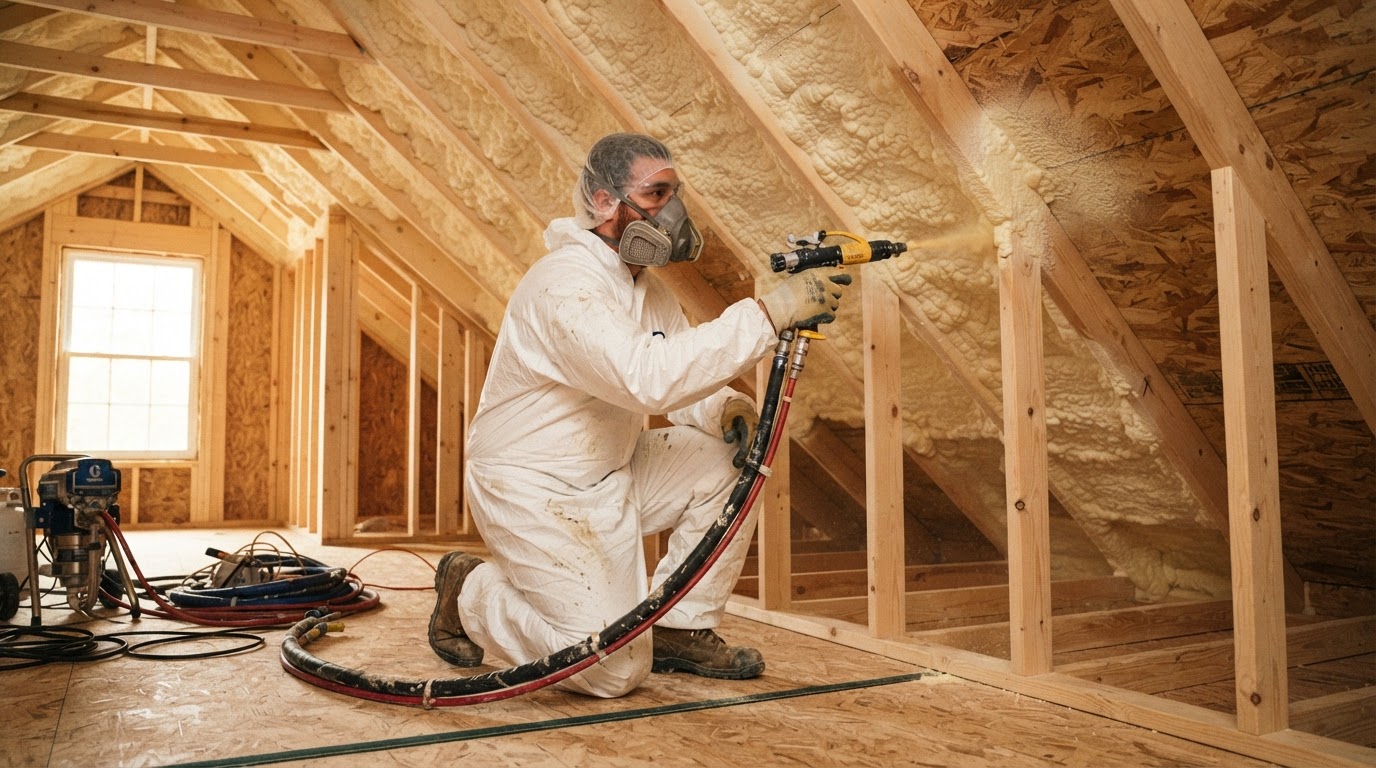
Attic Spray Foam InsulationSpray foam applied along a residential attic roof deck and framing system.
Attic Spray Foam InsulationAttic air-sealing and spray foam coverage around complex roof framing.
Crawl Space Spray Foam Insulation Near Wilmington
Crawl-space spray foam projects may involve rim joists, band boards, floor systems, or qualifying foundation-wall assemblies depending on the property's moisture strategy, ventilation configuration, and building-envelope design.
Crawl Space Spray Foam InsulationSpray foam air-sealing at crawl-space framing and rim-joist areas.
Crawl Space Spray Foam InsulationCrawl-space insulation application coordinated with the building-envelope system.
Open-Cell Spray Foam Insulation in Wilmington
Open-cell spray foam may be appropriate for selected interior wall, roof-deck, and framed assemblies depending on project goals, code requirements, moisture conditions, and building design.
Open-Cell Spray Foam InsulationOpen-cell spray foam applied throughout a framed insulation assembly.
Closed-Cell Spray Foam Insulation Near Wilmington
Closed-cell spray foam provides a dense insulation and air-sealing layer and may be considered for qualifying walls, roof assemblies, metal structures, and other applications based on the project's performance and moisture-management requirements.
Closed-Cell Spray Foam InsulationDense closed-cell spray foam applied across a prepared building surface.
Pole Barn Spray Foam Insulation in Wilmington
Pole-barn insulation projects may include walls, roof decks, and metal-panel assemblies where spray foam is selected to improve the building envelope and help manage air leakage and condensation risk.
Pole Barn Spray Foam InsulationSpray foam installed across a pole-barn wall and roof assembly.
Metal Building Spray Foam Insulation Near Wilmington
Spray foam can be applied to qualifying metal-building wall and roof panels to create a continuous insulation and air-sealing layer while helping address condensation and thermal-transfer concerns.
Metal Building Spray Foam InsulationSpray foam insulation applied directly to a prepared metal-building assembly.
Workshop Spray Foam Insulation in Wilmington
Detached and attached workshops may benefit from spray foam along walls, roof assemblies, and other exposed framing where improved air sealing and insulation are part of the planned building-envelope strategy.
Workshop Spray Foam InsulationSpray foam insulation installed throughout an enclosed workshop structure.
Garage Spray Foam Insulation Near Wilmington
Garage spray foam projects may involve exterior walls, ceilings, bonus-room floor assemblies, and roof framing where insulation and air sealing are needed.
Garage Spray Foam InsulationSpray foam insulation installed across garage walls and ceiling framing.
New Construction Spray Foam Insulation in Wilmington
New-construction spray foam projects can be coordinated before drywall and interior finishes so wall cavities, roof assemblies, penetrations, and other planned building-envelope areas remain accessible for proper application.
New Construction Spray Foam InsulationSpray foam insulation integrated into a new-construction building envelope.
Existing Home Spray Foam Insulation Near Wilmington
Retrofit spray foam projects may involve accessible attics, additions, crawl spaces, bonus rooms, exposed framing, and other areas that can be insulated without misrepresenting inaccessible finished cavities.
Existing Home Spray Foam InsulationTargeted spray foam installation in an accessible existing-home assembly.
Spray Foam Insulation Removal in Wilmington
Spray foam removal may be required when existing material must be accessed, corrected, or removed as part of a qualifying renovation, repair, or building-envelope project. Not every spray foam installation requires removal.
Spray Foam Insulation RemovalControlled removal of existing spray foam from an accessible framed assembly.
Discuss Your Spray Foam Insulation Project in Wilmington
Contact Wilmington Spray Foam Installation to discuss your structure, insulation goals, and the areas you are considering for spray foam. Property owners can share a project address or general location, type of structure, requested insulation area, existing insulation condition, approximate square footage where known, attic, crawl-space, wall or building photographs, new construction or existing structure status, and preferred service timeline. Providing photographs, approximate dimensions, and basic project details can help the team better understand the requested work before determining the next step.
Spray Foam Insulation Near Wilmington and Across Southeastern North Carolina
Wilmington Spray Foam Installation is based in Wilmington, NC 28403 and serves property owners across the surrounding region. Our primary market is Wilmington and New Hanover County, and our service footprint reaches into portions of Brunswick County, Pender County, Onslow County, and Columbus County. From the beaches to the inland communities, we help homeowners, builders, commercial property owners, and agricultural customers plan spray foam insulation that fits southeastern North Carolina building conditions.
Coastal humidity, hot attic temperatures, and crawl-space moisture are common across this region, and the right insulation approach can vary from one community to the next. If your town is listed below, follow the link to learn more about spray foam in your area. Wilmington remains our primary market, with these surrounding communities served from our Wilmington base.
Don’t See Your Area?
Call to discuss your project location—we may still be able to help.
Wilmington Spray Foam Insulation FAQs
Straightforward answers to the questions Wilmington homeowners, builders, and property owners ask most about spray foam insulation.
Ready to Discuss Spray Foam Insulation in Wilmington, NC?
Whether you’re a homeowner, builder, commercial property owner, or structure owner, we’ll review your project and recommend an approach that fits your building assembly. Request a free estimate or call us directly to get started.